
5 Free or Low-Cost Speech and Language Activities to Try at Home
You may be wondering whether you need specialist toys, expensive apps or prepared worksheets to support your child’s communication at home.
The reassuring answer is no.
Some of the best opportunities for developing speech, language and communication happen during ordinary activities such as getting dressed, preparing food, sharing a book or going for a walk. What matters most is not the activity itself, but how you join your child, respond to their communication and make space for interaction.
What might you notice?
Your child may:
Use fewer words than other children of a similar age
Find it difficult to combine words into sentences
Become frustrated when they cannot communicate what they want
Have difficulty understanding questions or instructions
Need additional time to process spoken language
Find it difficult to learn or remember new words
Use gestures, sounds, movement, signs, pictures or AAC to communicate
Repeat words or phrases they have heard
Communicate more during familiar or preferred activities
Speak comfortably at home but communicate less in unfamiliar situations
Every child communicates differently. These signs do not automatically mean that something is wrong, but they may suggest that your child would benefit from additional support.
How do everyday activities support communication?
From a speech and language therapist’s perspective, children are more likely to communicate when an activity is meaningful, enjoyable and shared with a responsive adult.
You do not need to continually ask questions or persuade your child to repeat words. Instead, try to:
Follow your child’s interests
Notice and respond to all forms of communication
Use short, clear language
Comment on what your child is doing
Pause and allow processing time
Repeat and gently add to what your child communicates
Communication includes much more than speech. Looking, pointing, reaching, showing, signing, moving, making sounds, using pictures and using an AAC system are all valid ways to communicate.
Here are ten simple activities you can try using things you probably already have at home.
1. Make snack time interactive

Snack time offers natural opportunities for requesting, choosing, commenting and taking turns.
Show your child two options and name them:
“Apple or banana?”
Pause and wait. Your child might answer by looking, pointing, reaching, signing, using a picture or saying a word. Respond to whichever form of communication they use.
You can also model useful words such as:
More
Finished
Open
Help
Big
Crunchy
Sweet
Avoid withholding food until your child says a word. The aim is to create an opportunity for communication, not to make speech a condition of receiving something.
2. Sort the laundry together
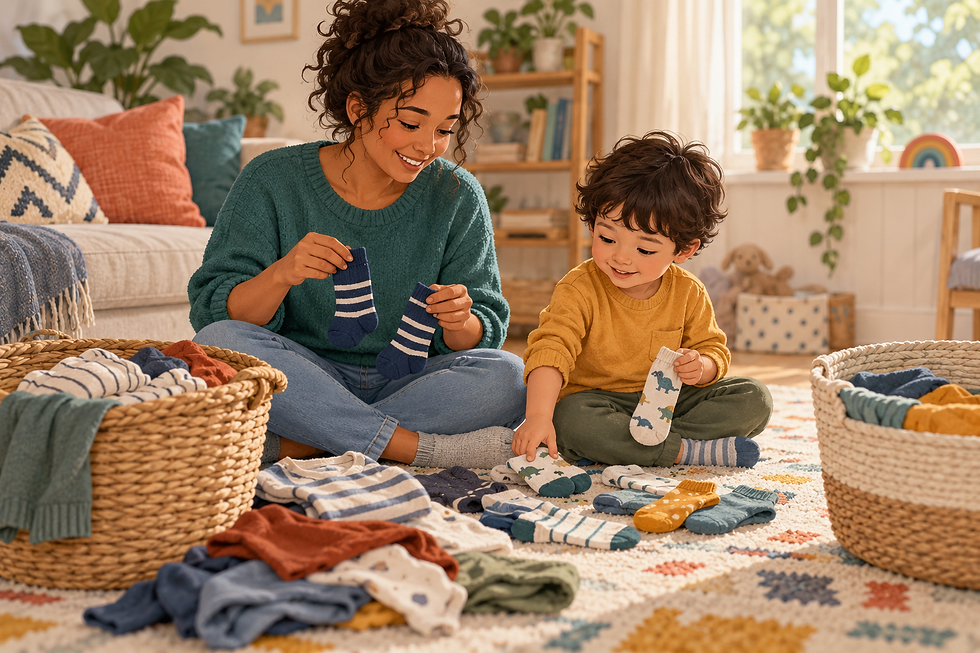
Laundry can support vocabulary, matching, categorisation and understanding instructions.
You could:
Match pairs of socks
Sort clothes by person, type or colour
Look for something big, soft or stripy
Put clothes “in” and take them “out”
Talk about whose clothes they are
Try making comments rather than asking lots of questions:
“I found a tiny sock.”
“Your top is blue.”
“This towel feels soft.”
If you are practising instructions, begin with something short and meaningful:
“Put the sock in.”
Allow time for your child to process the instruction before repeating it or offering help.
3. Create a mystery bag

Place a few familiar objects inside a bag, pillowcase or box. Take turns choosing an object without looking.
Talk about how the object feels, what it does and where you might find it:
“It feels hard.”
“We use it at mealtimes.”
“I think it might be a spoon!”
This can support vocabulary, describing, prediction and turn-taking. Your child does not have to answer questions. They can explore the object while you model the relevant words.
You could use a spoon, toy car, sock, brush, cup, ball or other familiar household objects.
4. Share a book without testing your child

Books can support vocabulary, sentence development, understanding, prediction and storytelling. You do not have to read every word or finish the whole book.
Follow your child’s interest in the pictures and talk about what they notice.
Instead of repeatedly asking, “What is this?”, try making comments:
“That dog is hiding!”
“Oh no, the cup fell over.”
“She looks excited.”
Pause occasionally to give your child an opportunity to respond. If they communicate one word, you can gently add another:
Child: “Dog.”
Adult: “Big dog.”
If your child turns the pages quickly, repeats a familiar line or wants the same book again, this can still be meaningful participation.
5. Go on a listening or noticing walk

Take a short walk around your home, garden or local area and notice what is happening together.
You might hear or see:
A car
Birds
Footsteps
A door closing
Leaves moving
A dog barking
Model simple comments:
“I hear a car.”
“That bird is loud.”
“The leaves are moving.”
There is no need to ask your child to identify everything. Simply noticing something together can create a valuable moment of shared attention.
If outdoor environments are overwhelming for your child, try looking and listening from a window or choose a quieter location.
Helpful communication strategies to use during any activity
Whichever activity you choose:
Follow your child’s interests
Reduce background distractions where possible
Use language that is only slightly above your child’s current level
Comment more and question less
Pause for several seconds to allow processing time
Respond to gestures, sounds, signs, pictures and AAC
Avoid forcing eye contact
Avoid repeatedly asking your child to “say it”
Adapt or stop the activity if your child appears overwhelmed
Keep activities brief, enjoyable and pressure-free
You do not need to complete all five activities. Choose one that fits naturally into your existing routine and try it for a few minutes.
What might this look like in everyday life?
If your child points towards the bubbles, you might say:
“Bubbles! You want more bubbles.”
If your child says, “Car,” you could add:
“Yes, the car is going fast.”
If your child repeats, “Time to go,” after hearing the phrase previously, you could respond to its possible meaning:
“You’re telling me you want to leave.”
If your child communicates using an AAC system, you can model words on their system while speaking, without expecting them to copy you.
If your child does not respond immediately, wait. They may need additional time to understand what was said, organise a response or feel ready to communicate.
When should I seek further advice?
Consider speaking to a speech and language therapist if:
You are worried about your child’s communication
Your child is frequently frustrated because others do not understand them
They appear to have difficulty understanding everyday language
Their speech is difficult for familiar or unfamiliar people to understand
Communication differences are affecting learning, relationships or participation
Nursery or school staff have also raised concerns
You are unsure how to support signs, pictures or AAC
Your child has lost communication skills they previously used
You do not have to wait until a difficulty becomes severe before asking for advice. An assessment can help identify your child’s strengths, understand their individual needs and decide whether further support would be helpful.
If your child has suddenly lost speech or other previously acquired skills, seek medical advice promptly.
Related articles
You may also find these Little Gems Speech Therapy articles helpful:
Is My Child a Late Talker? A Gentle UK Guide for Parents
Best Toys to Encourage Speech in Toddlers with Language Delay
10 Speech and Language Apps parents may want to explore for their children
Supporting Late Talkers Without the “Wait-and-See”
The Importance of Attention and Listening Skills in Preschoolers’ Speech and Language Development
Would you like individual advice?
If you are concerned about your child’s speech, language or communication but are unsure what support they need, book a free 10-minute telephone consultation with Little Gems Speech Therapy. We can briefly discuss your concerns and identify the most appropriate next step for your child.


Comments